



Please welcome Julie Musil to the blog today as she discusses absent characters. Guest posts are a new feature here. If you’re interested in submitting a guest post for consideration, you can send them to traci.kenworth at hushmail.com.
How to Make Readers Care About an Absent Character
In my latest release, The Summer of Crossing Lines, 16 year old Melody’s beloved older brother goes missing. Frustrated by a slow investigation with too many obstacles, Melody embarks on her own quest to find him.
For most of the book, Melody’s older brother Wyatt is absent. I was faced with this problem: how do you make readers care about a character who is missing for most of the story?
Here are some tools to handle that pesky issue:
Early Scene with an Absent Character
If possible, write an early scene with the soon-to-be absent character that shows why readers should care about him. Also hint at the mystery about to unfold.
In my book, the opening scene takes place with Melody and her brother Wyatt. Readers get a glimpse into their relationship–how Wyatt protects and encourages his younger, stuttering sister. They also catch a glimpse of something not being quite right–Wyatt shows up late with a bruise on his face. He’s not on stage for long, but he’s there long enough for readers to meet him and hopefully worry about him.
Flashbacks and Memories
Another method used to acquaint readers with an absent character is to write short flashbacks and memories.
A well-timed memory flows naturally within the text. For instance, Melody watches a little girl swing at a piñata in the park. She remembers when she was little, how Wyatt used to stand behind her and provide the muscle when she swung a bat at the piñata.
Memories of Wyatt’s temper show the reader that he’s human. Memories of his protective nature help the reader understand why Melody misses him so much. These quick references to Wyatt serve as a way for readers to get to know him.
Art
Readers can get to know an absent character through words and/or pictures.
Some authors reference diary or social media entries to get to know an absent character. Were the entries angry? Hurtful? Sad? Were the entries plentiful but then dropped to zero? Did his social media rants start small then turn into essays? Is he an artful tagger?
In The Summer of Crossing Lines, we learn a lot about Wyatt through his drawings. Their parents made white headboards for each of their children and allowed them to draw on the blank canvas. After Wyatt goes missing, these drawings provide Melody with fresh insight into what was going on in his life before he disappeared. What had once seemed like senseless doodling now becomes a chain of clues–a sailboat, the letter M, the word freedom.
My hope is that readers will care for Wyatt and worry about him, even though he’s missing throughout most of the story.
These are only three ways to allow readers to care about an absent character. Can you think of more? Please share!
Julie Musil writes from her rural home in Southern California, where she lives with her husband and three sons. She’s an obsessive reader who loves stories that grab the heart and won’t let go. Her YA novels The Summer of Crossing Lines and The Boy Who Loved Fire are available now. For more information, or to stop by and say Hi, please visit Julie on her blog, on Twitter, and on Facebook.
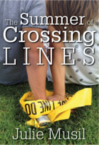
Media kit for THE SUMMER OF CROSSING LINES
Title: The Summer of Crossing Lines
Author: Julie Musil
Release date: August 19, 2014
Category: Young Adult (YA)
Genre: Contemporary Mystery
Short Summary
When her protective older brother disappears, sixteen-year-old Melody infiltrates a theft ring, gathers clues about his secret life, and falls for a handsome pickpocket. At what point does truth justify the crime?
Summary
When her protective older brother disappears, sixteen-year-old Melody loses control of her orderly life. Her stuttering flares up, her parents are shrouded in a grief-induced fog, and she clings to the last shreds of her confidence.
The only lead to her brother’s disappearance is a 30-second call from his cell phone to Rex, the leader of a crime ring. Frustrated by a slow investigation with too many obstacles, and desperate to mend her broken family, Melody crosses the line from wallflower to amateur spy. She infiltrates Rex’s group and is partnered with Drew, a handsome pickpocket whose kindness doesn’t fit her perception of a criminal. He doesn’t need to steal her heart—she hands it to him.
With each law Melody breaks, details of her brother’s secret life emerge until she’s on the cusp of finding him. But at what point does truth justify the crime?
Bio
Julie Musil writes from her rural home in Southern California, where she lives with her husband and three sons. She’s an obsessive reader who loves stories that grab the heart and won’t let go. Her YA novels The Summer of Crossing Lines and The Boy Who Loved Fire are available now. For more information, or to stop by and say Hi, please visit Julie on her blog, on Twitter, and on Facebook.
Social Media Links:
Goodreads/The Summer of Crossing Lines
Buy Links for The Summer of Crossing Lines:

 Traci Ashbe Dark Fantasy Author
6 responses to “Welcome, Julie Musil!!”
Traci, thanks so much for having me here!
LikeLike
It was a pleasure!! Sorry I didn’t get back to you sooner, I’ve been in the hospital.
LikeLike
Great post. This is a really important topic for mystery writers, since mysteries pretty much need a character to disappear or die rather quickly, but because they are the impetus for the action, they have to be compelling even with little stage time.
The Summer of Crossing Lines looks really interesting!
LikeLike
You’re so right!! Everything hinges on the disappearance of a character sometimes.
LikeLike
Connie, great point about mysteries. This was my first crack at writing a mystery, and boy, did a learn a lot. Also learned a lot about red herrings. Thanks for stopping by!
LikeLike
Mysteries are something I hope to learn to tackle in the future. I just adore reading them.
LikeLike